Fascination Microbiome
The gut microbiome - a superlative microcosm
With its 100 trillion (10¹⁴) microbes and a biomass of 1.5 to 2.5 kg, the intestinal microbiome is an ‘organ’ of superlatives. For example, the microbial genome, which contains up to 20 million genes, is many times larger than that of humans (22,000 genes). Scientists therefore now consider the gut microbiome to be an independent organ.
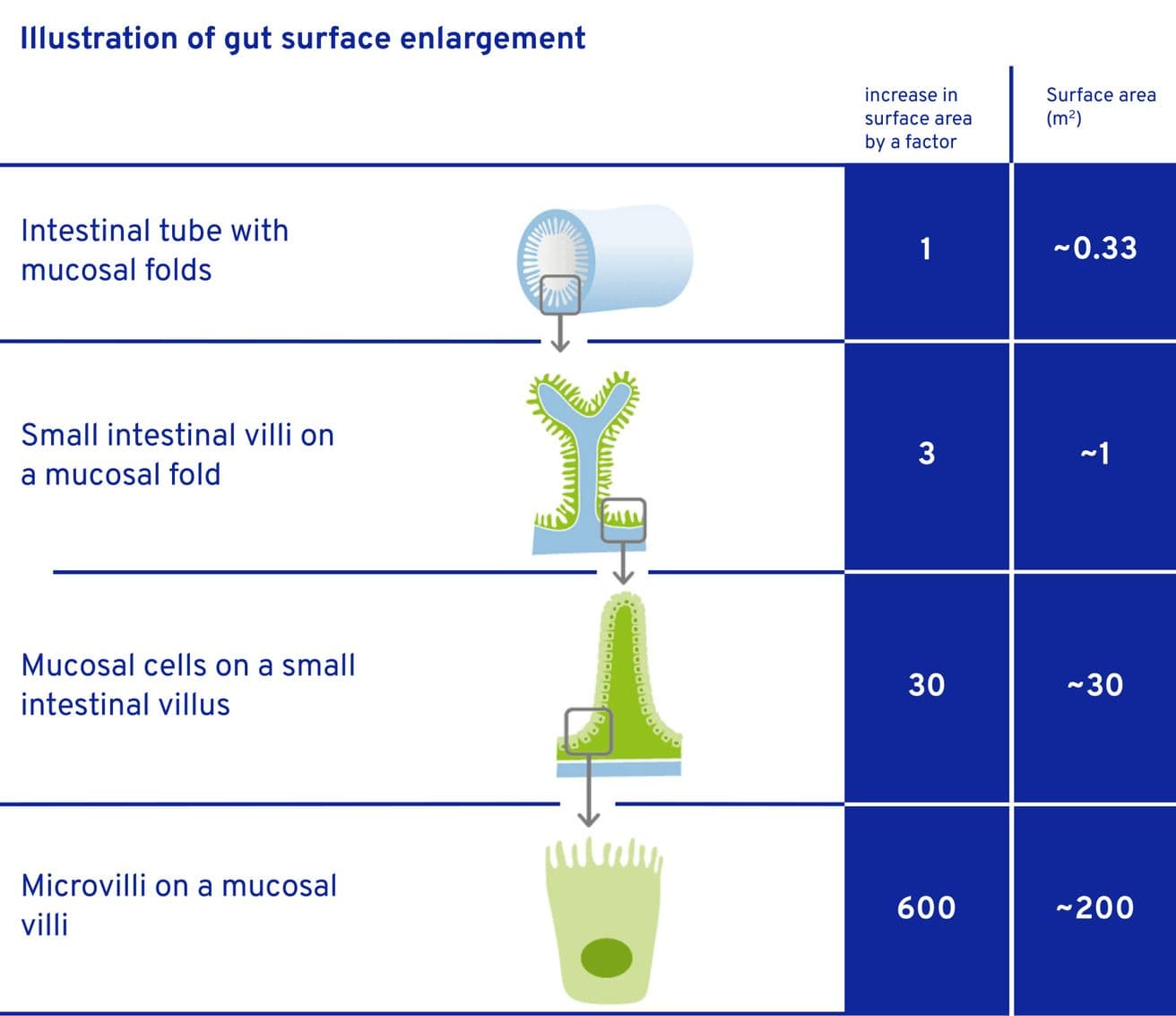
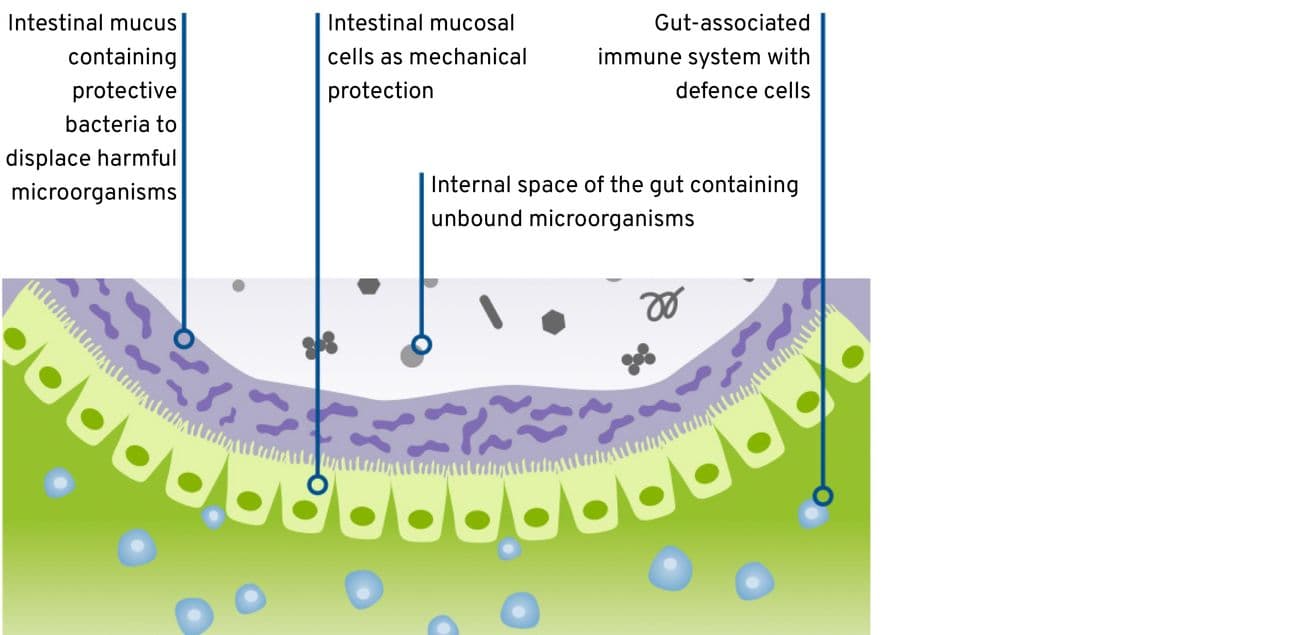
The graphic illustrates how this enormous increase in surface area is caused by folds, finger-like elevations and the protuberances located on the mucosal cells.
These distinct structures are necessary for the ingested food, which remains in the gut for several hours, to come into close contact with the surface of the intestine. Only in this way can the diverse components of the proteins, fats, carbohydrates as well as vitamins, minerals and trace elements ingested with food be absorbed quickly and comprehensively into the interior of the body.
At the same time, however, undesirable microorganisms and substances (such as bacteria, viruses, fungi or undissolved particles) can also enter the gut, so that it not only serves as a digestive organ for the absorption of nutrients and the elimination of undigested substances, but also has to perform protective functions for the body. The gut has several mechanisms to block the entry of harmful microorganisms and undissolved or large-molecular-weight substances into the body:
Illustration of protective barriers of the gut
Composition of the intestinal microbiome
With a share of around 99%, bacteria form the majority of the microbial ecosystem in the gut. Estimates currently range from 1000 to 1200 bacterial species which can be assigned to seven bacterial compartments, the so-called phyla. A ‘core microbiome’ consisting of about 57 species is found in 90% of people.
α-diversity
A characteristic of a healthy intestinal microbiome is a high species diversity (so-called α-diversity), accompanied by a low proportion of pathogenic organisms.
- In general, the higher the α-diversity, the more species-rich the corresponding microbiome. In general, a high α-diversity is an indicator of a stable and less susceptible microecological system. This is based on the ecological understanding that a species-rich ecosystem can compensate functionally for the loss of one or a few species by other species.
- Conversely, a low-species microbiome is unstable and associated with a number of adverse intestinal changes.
- To put it simply: High α diversity = ‘good’ vs. low diversity = ‘bad’
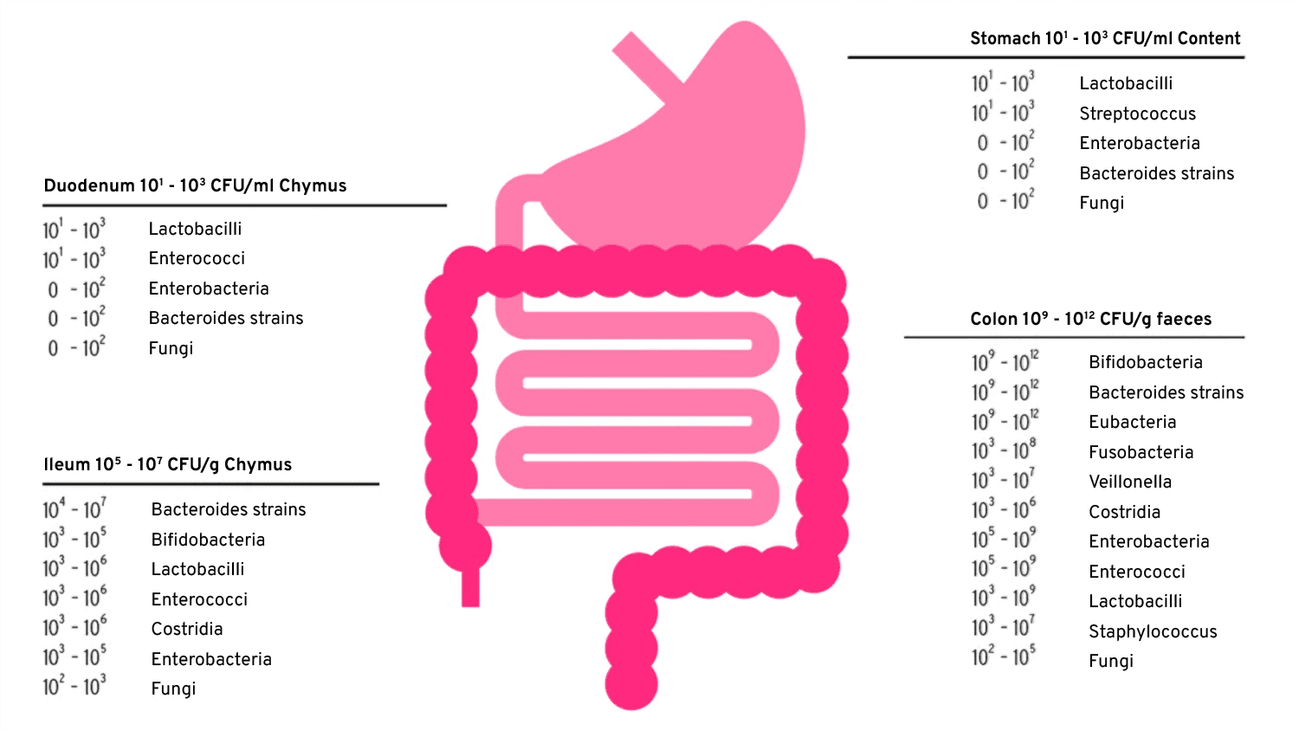
The bacteria that settle in the gastrointestinal tract are not distributed evenly among the different anatomic sections. The variable, selective living conditions (including pH, oxygen content and substrate supply) along the gastrointestinal tract instead require a characteristic segmentation of the microflora.
Key microbial groups of a physiological colonisation of different sections of the gastrointestinal tract
Microbiota development stages
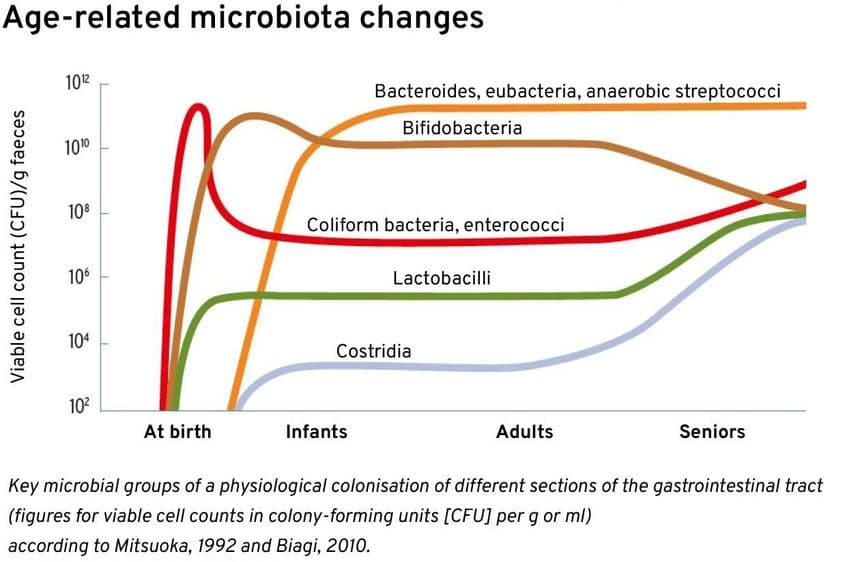
However, the qualitative and quantitative composition of the microbiota varies not only at different sites, but also depending on age. In general, four developmental phases can be identified in the microbiota over the course of a person’s life, each with typical age-dependent constellations of key microbial groups.
Following the germ-free state at birth, the initial colonisation phase occurs, with a microbiota that increasingly becomes established from around the 3rd to 5th year of life. Despite inter- and intra-individual variability, the population pattern installed up to early adolescence remains constant over several decades, as long as no disturbing factors affect the microflora. Around the age of 50, a qualitative and quantitative restructuring of the microbiota takes place again.
The age-typical changes affect, on the one hand, the relationships between the microbial groups (genera). The decline in the overall bifidobacterial flora as shown in the following graphic is particularly noteworthy. This is accompanied by an increase in coliform bacteria and certain Clostridium species that can have a mutagenic effect on intestinal mucosal cells.
On the other hand, however, the spectrum of bacterial species to be found also changes. For example, Bifidobacterium infantis is one of the dominant bifidobacterial species in infant intestinal flora and is not or only rarely detected in adult stool.
Age-related microbiota changes
Historical background of the microbiotic concept
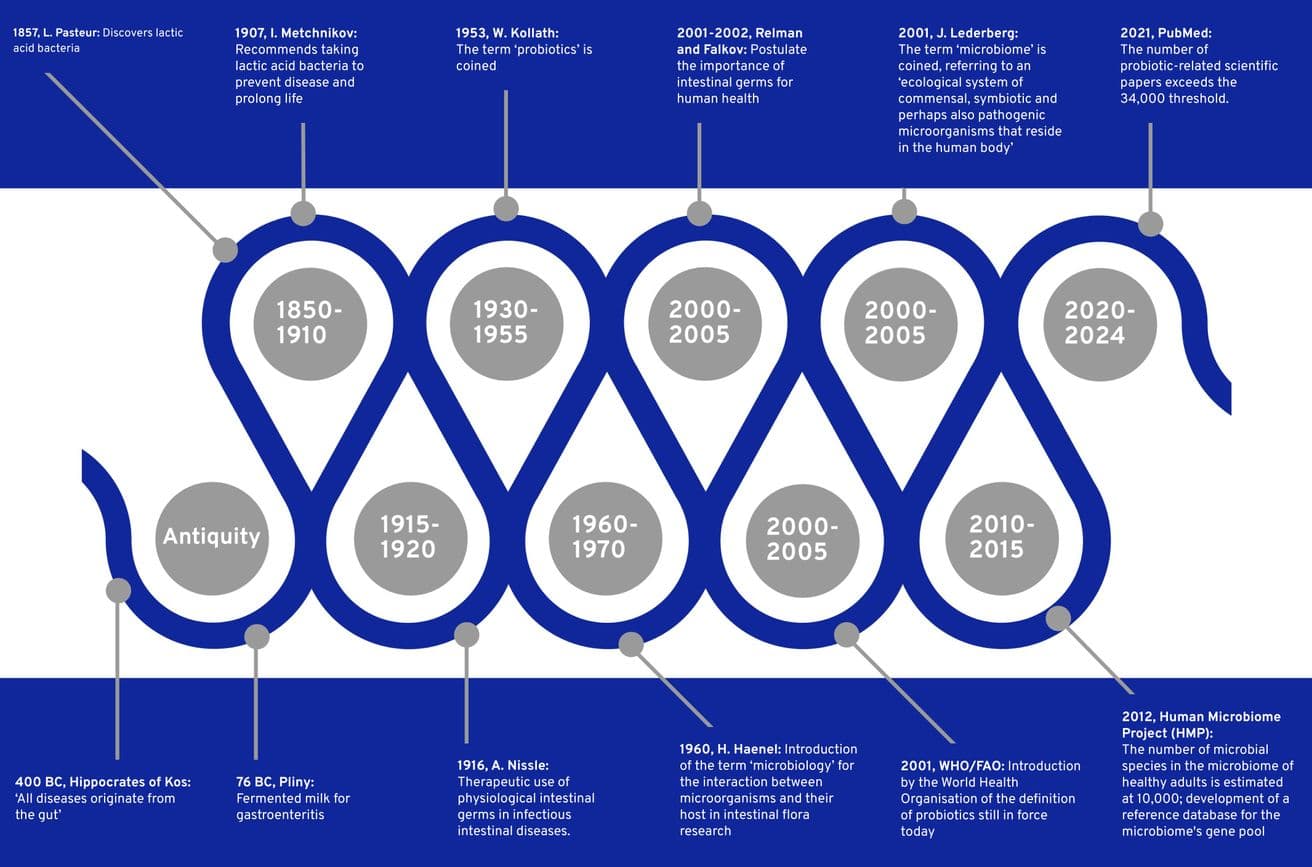
Although the definition of probiotics that is still valid today was only made at the beginning of the 21st century by the World Health Organisation (WHO), the underlying theoretical concepts go back far into the history of science. Thus, in the Corpus Hippocraticum, the medical writings of antiquity, the intestine was already regarded as the ‘gatekeeper of health’. Accordingly, the Greek physician Hippocrates of Kos postulated in the 4th century BC that ‘All diseases originate from the gut’.
However, it was to take until 1857, when the microbiologist Louis Pasteur (1822-1895) discovered lactic acid bacteria and published his research on lactic acid fermentation. This was an important step towards medical use. However, it is Ilya Mechnikov (1845–1916), a Russian researcher, who is considered the forefather of the microbiotic concept. He postulated in his 1907 publication Essais optimistes: ‘The opinion that all microbes are harmful is widespread, but completely wrong. There are microbes that are useful, and lactic acid bacteria have a place of honour among them.’
Mechnikov accordingly urged his contemporaries to eat yoghurt daily, which he considered a valuable source of lactic acid bacteria.
About 10 years later, the German physician and researcher Alfred Nissle (1874–1965) established the use of selected bacteria in infectious bowel diseases. Werner Kollath (1892-1970), a nutritionist, coined the term ‘probiotics’ in 1953. Important milestones such as the establishment of the scientific discipline of ‘microecology’ in the 1960s and the sequencing of the gut microbiome within the framework of the Human Microbiome Project in 2021 followed. In 2021, the number of scientific publications related to probiotics research finally reached the 34,000 threshold. Today, the microbiotic concept is firmly anchored in the knowledge canon of biomedicine and is increasingly finding its way into nutritional medicine practice.
Like fingerprints, each person has their own individual gut flora.